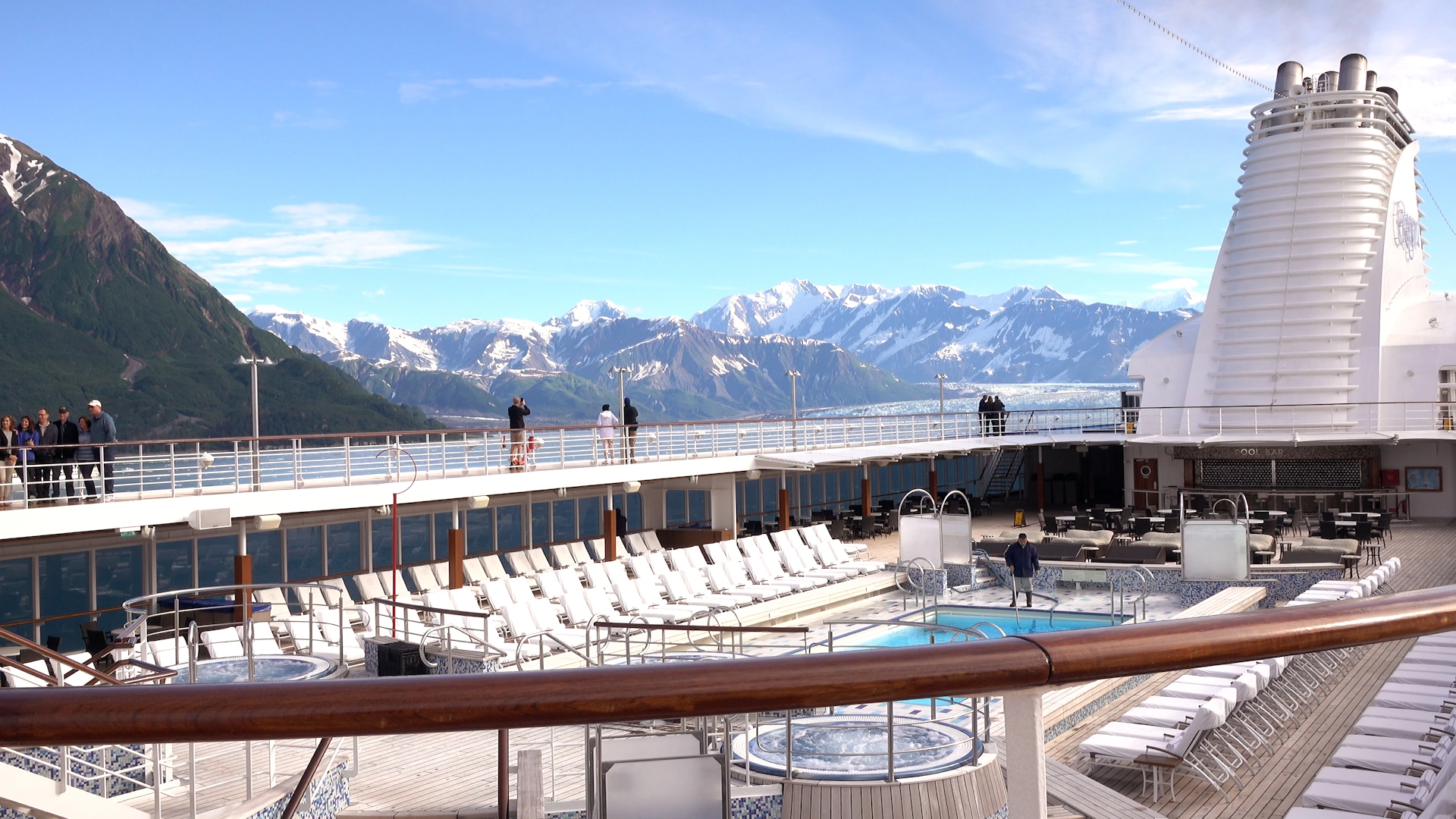
Discovering Inside Passage
The Inside Passage is not a destination in the traditional sense. It is a passage in the truest meaning of the word—a journey through water and wilderness, where the boundaries between land, sea, and sky feel fluid and ever-changing.
Here, the world is scaled differently. Forests rise in deep, impenetrable greens, their spruce and cedar canopies stretching toward mist-laced peaks. Fjords carve their way inland, quiet and immense, while waterfalls slip from unseen heights, dissolving into the sea below. The water itself is rarely still, yet always composed—sheltered by a chain of islands that soften the vastness of the Pacific beyond.
Wildlife defines the rhythm of the journey. A sudden breach of a humpback whale. The sharp arc of an orca slicing through dark water. Bald eagles poised in silent observation. These are not spectacles arranged for viewing, but moments that emerge—unexpected, unrepeatable.
Then there are the glaciers. Vast, luminous, and impossibly blue, they feel less like landscapes and more like living entities. When they calve—cracking, shifting, surrendering to the sea—the sound carries across the water with a kind of quiet force.
Time behaves differently here. Long summer days stretch into near-endless light, inviting hours spent simply watching—on deck, in silence, wrapped in warmth against the crisp air.
The Inside Passage is not hurried. It asks for attention, for stillness, for a willingness to observe rather than seek. And in return, it offers something rare: a sense of scale, of perspective, and of connection to a world that remains largely untouched.
Aboard the Seven Seas Explorer
A journey through wilderness is made all the more compelling when paired with a sense of refuge—and Seven Seas Explorer provides exactly that.
From the moment you step onboard, there is an unmistakable shift. Marble gleams softly underfoot, light filters through expansive windows, and every detail—down to the smallest finish—feels considered. Yet despite its refinement, the ship never feels detached from its surroundings. Instead, it frames them.
Suites are expansive, designed as private sanctuaries. Floor-to-ceiling glass opens onto balconies where glaciers drift into view and forested shores slip quietly past. Interiors favor calm tones and generous space, allowing the landscape to remain the focal point.
Public spaces are equally attuned to the journey. Observation lounges become gathering points during scenic cruising, where guests sit in quiet anticipation, watching for movement in the water or the distant fracture of ice. Heated outdoor decks extend the experience, allowing you to remain close to the elements without sacrificing comfort.
Dining is elevated yet unforced. Multiple restaurants offer varied cuisines, but always with a sense of place—fresh seafood, thoughtful wine pairings, and menus that evolve with the journey. Meals feel less like routine and more like punctuation between experiences.
Service is discreet, almost intuitive. Preferences are remembered, rhythms understood. There is no need to ask twice.
The Explorer does not compete with Alaska’s grandeur. It complements it—offering warmth, stillness, and refinement in a landscape defined by scale.
Cruising with Regent Seven Seas Cruises
Regent Seven Seas Cruises operates with a philosophy that aligns seamlessly with a destination like Alaska: remove the distractions, elevate the experience, and allow the journey itself to take precedence.
Everything is considered. Shore excursions, dining, beverages, and service are woven into a single, cohesive experience. The result is not indulgence for its own sake, but a sense of ease—travel without friction.
For the Inside Passage, this approach proves particularly effective. Days ashore are curated with intention: wildlife encounters led by naturalists, small-group explorations, and cultural experiences that offer genuine insight rather than surface-level observation. The emphasis is always on depth.
The Regent traveler is not seeking spectacle. They are drawn instead to nuance—to the quiet thrill of seeing a glacier up close, to the layered history of coastal communities, to the balance between exploration and restoration.
Onboard, the atmosphere reflects this sensibility. Conversations are thoughtful, the pace unhurried, the tone quietly sophisticated. Evenings are not about entertainment in the traditional sense, but about enrichment—music, lectures, shared experiences.
In Alaska, where the landscape itself commands attention, Regent’s restraint becomes its greatest strength. It allows the destination to lead, while ensuring that every moment—on land or at sea—is experienced with clarity, comfort, and intention.
Guide to Inside Passage Ports
Seward, Alaska
Seward feels like an introduction to Alaska in its purest form—unpolished, immediate, and defined entirely by its surroundings. Set along the edge of Resurrection Bay, it is less a town of grand attractions than a gateway to something far larger.
The true draw lies beyond its harbor, within Kenai Fjords National Park. Here, glaciers descend toward the sea, carving deep fjords that feel both immense and intimate. Boat journeys through these waters reveal a shifting landscape—ice fields, sheer cliffs, and the constant presence of wildlife. Puffins nest along rocky outcrops, sea lions gather in restless colonies, and whales surface with quiet, deliberate grace.
There is a rawness to the experience. The air is colder here, sharper. The wind carries the scent of salt and ice. When a glacier calves, the sound echoes across the bay—sudden, powerful, and impossible to ignore.
Back on land, Seward retains a certain simplicity. The harbor is lined with working boats and modest restaurants where seafood arrives fresh and unadorned. Murals add color to the town’s edges, telling stories of both nature and community.
For those seeking a closer connection to the landscape, trails lead outward—to viewpoints, to glaciers, to spaces where the scale of Alaska becomes fully apparent. Exit Glacier offers one of the most accessible encounters, its retreat a visible reminder of time and change.
Seward is not about lingering. It is about stepping briefly into the vastness—and carrying that sense of scale with you as you move on.
Sitka, Alaska
Sitka carries a different rhythm—one shaped as much by culture as by landscape. Framed by mountains and sea, it feels both remote and deeply connected to history.
Once the capital of Russian America, its past lingers in subtle but unmistakable ways. The onion domes of St. Michael’s Cathedral rise above the town, a reminder of its layered identity. Yet Sitka’s deeper story belongs to the Tlingit people, whose presence is felt throughout the region.
In Sitka National Historical Park, forest trails wind quietly along the shoreline, lined with totem poles that speak in carved form—stories of lineage, conflict, and resilience. There is a stillness here, one that invites reflection rather than observation.
Wildlife remains ever-present. Sea otters drift in the harbor, wrapped in their own quiet world. Bald eagles circle above, sharp and watchful. Offshore, whales move through deeper waters, their presence often revealed only by a distant breach or the soft plume of breath.
Sitka’s scale makes it immediately accessible. Streets are walkable, encounters unhurried. Small museums, local galleries, and conservation centers offer insight into both past and present, grounding the experience in something more meaningful than scenery alone.
What distinguishes Sitka is its balance. It does not overwhelm with grandeur, nor does it rely solely on history. Instead, it offers a layered experience—one where culture and nature exist not in contrast, but in quiet harmony.
Juneau, Alaska
Juneau occupies a rare position—both a capital city and a frontier outpost, accessible not by road, but by sea and air. It is here that Alaska’s wilderness feels closest, almost within reach.
The landscape rises sharply from the water. Forested slopes give way to mountains, and beyond them, ice. The Mendenhall Glacier draws visitors for good reason—its immense blue face a striking contrast against dark rock and sky. Trails and viewing platforms offer perspective, though the glacier itself resists full comprehension.
Wildlife excursions define much of the experience. Whale-watching boats move deliberately through nearby channels, tracking the feeding patterns of humpbacks. The encounters feel intimate, unscripted—moments that unfold rather than perform.
Yet Juneau also offers cultural depth. Indigenous heritage is present in art, storytelling, and community spaces, adding context to the landscape. Museums and local centers provide insight into traditions that extend far beyond the arrival of visitors.
The town itself is compact, its waterfront lined with shops, galleries, and cafés. There is an energy here—subtle but noticeable—shaped by both tourism and daily life.
For those willing to look beyond the obvious, Juneau reveals itself in layers. It is not simply a stop for glacier viewing, but a place where nature, culture, and modern life intersect—complex, evolving, and undeniably compelling.
Ketchikan, Alaska
Ketchikan greets you with rain more often than not—and it suits the place perfectly.
Known as part of Alaska’s temperate rainforest, the town is enveloped in deep greens and soft mist. Water is everywhere—falling, flowing, gathering—giving the landscape a sense of constant motion.
Its identity is closely tied to the traditions of Indigenous cultures, particularly evident in the totem poles found throughout the region. At Totem Bight State Historical Park, these carved forms stand among the trees, each one telling a story that extends far beyond its physical presence.
The town itself unfolds along wooden boardwalks and narrow streets. Creek Street, once a lively red-light district, now houses galleries and small shops perched above the water. There is a sense of history here, though it feels softened by time.
Salmon define another aspect of Ketchikan’s character. Streams run through and around the town, drawing fish—and with them, wildlife. Eagles gather overhead, while bears, at certain times of year, move quietly along the banks.
Despite its popularity, Ketchikan retains a sense of authenticity. It does not feel curated, but lived-in. The rain, the wood, the water—they shape both the environment and the experience.
It is a place that invites you to slow down, to look closely, and to embrace the elements rather than resist them.
Vancouver, Canada
Vancouver offers a different kind of arrival—one that feels both expansive and composed.
Framed by mountains and ocean, the city balances natural beauty with urban sophistication in a way that feels almost effortless. From the waterfront, glass towers reflect shifting light, while beyond them, forested peaks rise in quiet contrast.
The city invites exploration at many levels. In Stanley Park, paths wind through towering trees and along the seawall, offering uninterrupted views of water and sky. It is a place where nature feels integrated, not separate.
Markets, particularly on Granville Island, provide a more intimate experience—food, craft, and local life converging in a vibrant, sensory space. Nearby neighborhoods reveal the city’s diversity, each offering its own perspective and rhythm.
Yet Vancouver’s true strength lies in its balance. It is neither overwhelming nor understated, neither purely urban nor entirely natural. Instead, it exists comfortably between worlds.
As either a beginning or an end to the journey, it provides a fitting transition—one that gently reintroduces the pace of modern life, while still holding onto the clarity and perspective shaped by the Inside Passage.
Most Recent from The Blog
- BREAKING NEWS: Royal Caribbean Group Buys 50% of Sandals Resorts – A Gamechanger for Caribbean - and Global? Cruising
- Gaudí at 100: Barcelona's Most Famous Architect "Raising the Roof" of the City
- The "Greatest Show on Earth:" Scotland's Royal Edinburgh Military Tattoo


